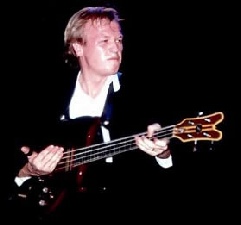
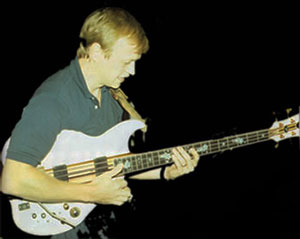
During the British Music Fair of 1982 I received a call from Sounds saying
they had a customer who was prepared to pay cash for the bass and
they could sell it! Of course I said yes. I needed the money then and I
was glad of the sale. Little did I know whom the bass was being sold to.
Later that year I saw that very same instrument being played on
Top Of The Pops by a new band called Level 42, the bass player
being Mark King and the song was ‘Love Games’. I was completely
bowled over and nearly choked on my dinner. After that appearance
I was inundated with calls with calls about the bass from both shops
and private customers. One call was from Mark King himself, which was
the start of our working relationship as well as being good friends.
With the continued interest in the basses and Level 42’s popularity,
it was all systems go. Then I had a call from a guy called Steve Barnacle,
brother of level 42 sax player Gary Barnacle, who had seen Marks bass
and decided he would like to have one made. He wanted one smaller in
width and with black outriggers.
Shortly after it was made I had a call from Mark saying he had seen Gary’s bass and he would like one the same.
This was Marks second bass, which he came to collect in person. Unbeknown to me my sons had hidden a tape
recorder in the room and the whole event was recorded virtually from the time Mark walked through the door.
He even played a bit of ‘Dune Tune’, nice!
The big break into the bass world came after making an active model in cherry red with the Saturn/crescent inlays.
This instrument was reviewed in a magazine called International Musician In August 1980. From there it was
displayed in the shop ‘Sounds’ in Shaftsbury Avenue.
Anyway, having made the decision to go for the smaller body
size, Mark came to the conclusion that is wasn’t for him and
asked if I could make another of the larger size. It was around
the time when Starchild was released as asngle that I had the
inspiration to do something different. I still had some basses
lying around the workshop thathad been made in anticipation.
Some were large bodies and some were small (series II). The
one I used was a Session Series I model. It had bookmatched
Brazilian Walnut outriggers and the more rounded contours on
the body. The finished bass was pure white with a Maple and
Walnut laminated neck and body centre. The idea for the inlays
came from a Christmas card I’d had from my mother that
featured cherubs and angels. I chose one of the cherubs and
enlarged it to a suitable size for an inlay. It was good because
it had movement and all I had to do was reverse it every other
inlay position to balance the whole effect, and the stars just
slotted into the respective standard positions. The pick-ups
were all ebony tops, each having a series / parallel switch for
more tone variation.
2008 Jaydee Custom Guitars
The active tone control knobs were made of ebony inlayed with stars. The master volume and master tone were
brass hexagons. It was later on when the bass was being used that Mark wanted a tremolo unit fitted, and the
infamous roller nut, which I designed in 1978.
Today Mark still has two Jaydees in his possession, these being the Birthday Bass and his first Jaydee Classic Series 1.
Click here to see a picture of Mark’s two remaining Jaydee basses.
Click here to see exclusive pictures of Mark’s original ‘Classic’ bass.